
Common Repair Solutions for Excessive Clearance
The choice of method depends on equipment value, downtime cost, and extent of wear:
Replace the Bushing: The most thorough and reliable method. Suitable when the shaft journal has minimal wear. The key is selecting a new bushing with the correct initial interference fit based on the shaft's actual dimensions.
Repair the Shaft and Fit a New Bushing: For significantly worn shafts, processes like thermal spraying, electroplating, or welding can restore the journal size and hardness. A custom-made bushing with an enlarged inner diameter is then fitted.
Use Adjustment Shims: For some split structures (e.g., large babbitt bearings), precision shims can be added at the joint to reduce the bearing bore diameter, temporarily restoring proper clearance. This is often a temporary or emergency measure.
Replace the Entire Assembly: For high-value, high-precision, or highly integrated components, replacing the entire module (including both shaft and bearing) can sometimes be the most economical and reliable option from a maintenance perspective.
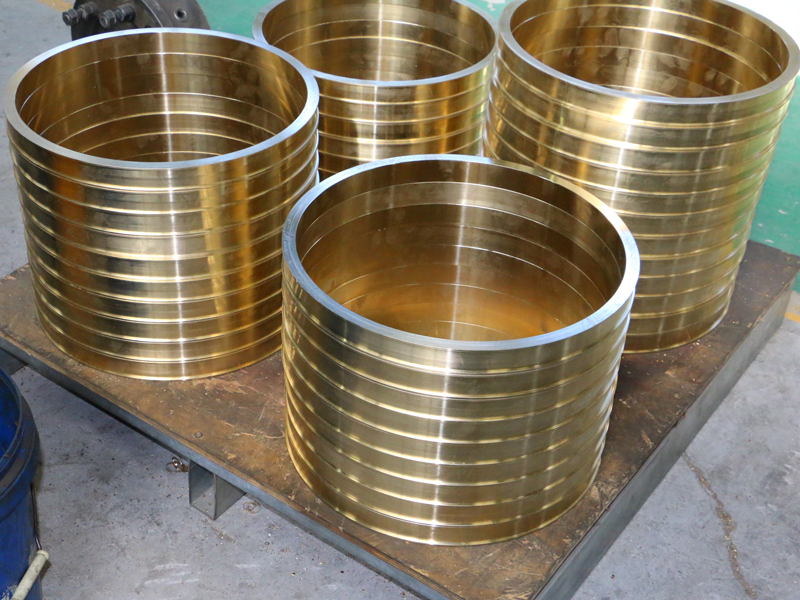
High-Quality Bushing Supplier Reference: Haishan Machinery Co., Ltd.
When bushing replacement is needed, choosing a reliable product ensures long-term repair stability.
Company Profile: Haishan Machinery specializes in developing and manufacturing high-performance copper alloy components, widely used in heavy equipment, mining machinery, and general power transmission. The company possesses full-chain capabilities from material processing and precision casting to CNC machining.
Main Product Specifications: Supplies various standard and custom tin bronze, aluminum bronze, and high-strength brass bushings. For repair needs, they can provide bushings with enlarged inner diameters and recommend scientific fit tolerances based on measured shaft data.
Key Advantages: Their products utilize advanced processes like centrifugal casting, ensuring uniform, dense material and stable mechanical properties. Strict dimensional accuracy control helps guarantee that the repaired assembly meets design clearance requirements, reducing repeat failures due to part quality issues.
.jpg)
Key Points for Bushing Selection and Repair Implementation
Precise Measurement: Before repair, accurately measure the actual shaft diameter and bushing housing bore using tools like micrometers and bore gauges to determine the existing clearance and wear amount.
Determine Fit Tolerance Scientifically: The fit (interference or clearance) for the new bushing must be based on original equipment specifications or relevant mechanical design handbooks, considering factors like speed, load, and lubrication method.
Follow Proper Installation Procedures: Whether pressing or heating for installation, use appropriate tools to ensure the bushing is installed smoothly and squarely, preventing scoring or deformation. After installation, check for proper alignment of oil holes and grooves.
Adequate Lubrication and Run-in: After installation, apply sufficient specified lubricant. A light-load run-in period during initial operation is recommended to facilitate proper surface conditioning of the friction pair.
Future Outlook
With the advancement of the remanufacturing industry, repairs for shaft-bushing pairs will become more specialized and standardized. Future technologies like wear assessment via 3D scanning and rapid fabrication of matched bushings or repair layers using additive manufacturing (3D printing) promise more precise, efficient, and customized repairs, further enhancing the management value of equipment throughout its lifecycle.

.jpg)